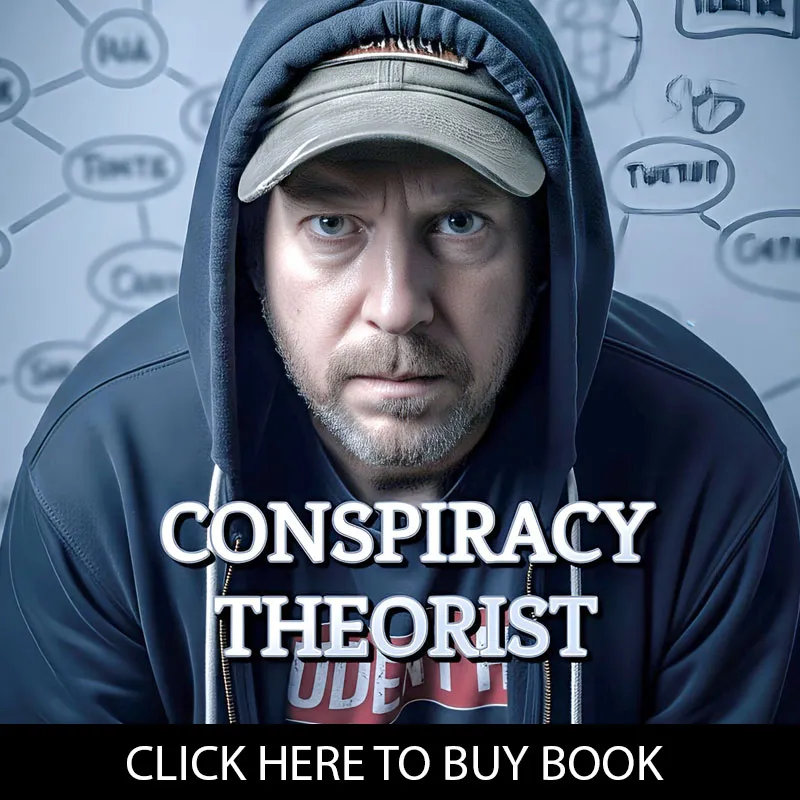
CONSPIRACY THEORIST
Success message
Error message
Conspiracy Theorist is an investigative exploration of some of the most infamous conspiracy theories and significant historical events that have shaped public perception and trust in institutions. This comprehensive narrative delves into the complexities of human belief, the interplay between truth and misinformation, and the societal consequences of conspiracy theories in the digital age.
Through a series of meticulously researched chapters, the book examines pivotal moments in history, including the assassination of prominent figures like John F. Kennedy and Robert F. Kennedy, the tragic events of the Sandy Hook Elementary School shooting, and the enigmatic disappearance of Malaysia Airlines Flight MH370. Each chapter provides an overview of the events, scrutinises conspiracy theories that have emerged, and highlights the impact of these narratives on public discourse.
The book also critically analyses the role of government actions, media portrayal, and the influence of social media in perpetuating misinformation and shaping public perception. From the MKUltra mind control experiments to the enigmatic Area 51 and the implications of the Dreyfus Affair, Conspiracy Theorist reveals the intricate web of fear, distrust, and fascination that surrounds conspiracy theories.
As the narrative unfolds, readers are encouraged to engage with the ethical dilemmas posed by these events, reflecting on the importance of transparency, accountability, and the pursuit of truth in a world rife with uncertainty. The long-term implications for civil liberties, public trust, and the integrity of democratic institutions are examined, prompting readers to consider the role they play in shaping the discourse surrounding these critical issues.
Through a thoughtful and nuanced exploration, Conspiracy Theorist invites readers to question their assumptions, engage with the complexities of modern life, and advocate for a society grounded in empathy, understanding, and a commitment to uncovering the truth.
BRITISH AUTHOR KEVIAN | Science Fiction | Self-Help | Futuristic Visions | Produced in England. Welcome to the world of Kevian — a British author, futurist, and creative visionary whose ground-breaking books dive deep into the world of AI technology, science fiction, human consciousness, and personal transformation.

Conspiracy Theorist is a critical examination of why conspiracy theories endure, how they form, and what they reveal about trust, power, and human psychology. Rather than sensationalism, the book takes a grounded, investigative approach, separating verifiable fact from speculation while exploring why certain narratives refuse to disappear.
The book revisits pivotal historical events that continue to provoke doubt and debate. From the assassinations of John F. Kennedy and Robert F. Kennedy to the disappearance of Malaysia Airlines Flight MH370 and the tragedy of Sandy Hook, each case is examined with care. The events are outlined clearly, followed by an analysis of the conspiracy theories that emerged and why they gained traction.
These chapters do not seek to promote alternative truths. Instead, they expose how uncertainty, trauma, and lack of transparency create space for speculation to grow.
Conspiracy Theorist also explores documented government actions that fuel distrust, including MKUltra, covert surveillance programmes, and classified military operations. Topics such as Area 51 and the Dreyfus Affair are used to show how secrecy, even when justified, can damage long-term public confidence.
The book asks a difficult question: when institutions hide information, even for legitimate reasons, how can trust ever fully recover?
A significant focus is placed on the digital age. Social media algorithms, online echo chambers, and sensationalist news cycles are examined as accelerants of misinformation. The book shows how emotionally charged content spreads faster than nuance, and how belief can become identity.
This section highlights how conspiracy theories are no longer fringe ideas, but cultural forces that influence elections, public health, and social cohesion.
Rather than ending in cynicism, Conspiracy Theorist encourages critical thinking, empathy, and accountability. It challenges readers to question sources, recognise cognitive bias, and understand why people are drawn to simplified explanations in a complex world.
Ultimately, the book is about more than conspiracies. It is about how societies respond to uncertainty, how truth competes with narrative, and how the pursuit of understanding remains essential in an age defined by noise.