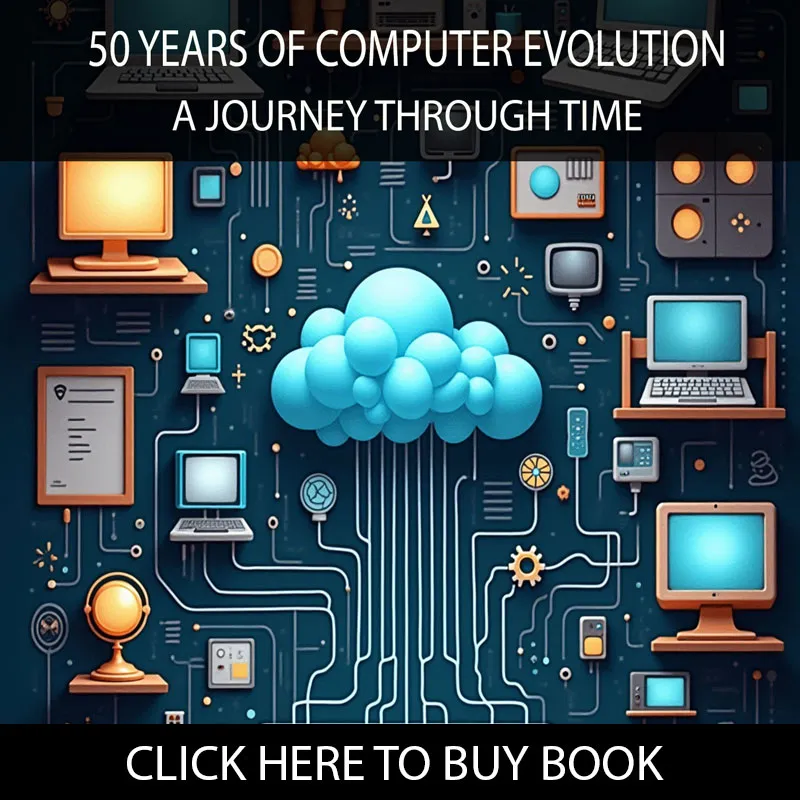
50 YEARS OF COMPUTER EVOLUTION
Success message
Error message
: 50 Years of Innovation – A Technological Journey Through Time
“50 Years of Innovation”
Structure Overview
The book is divided into over 40 chapters, each focusing on a key period, invention, or thematic development in computing. From mainframes to microprocessors, from floppy disks to cloud computing, from basic programming languages to artificial intelligence—this book serves as both a historical account and a cultural reflection.
Part I: The Foundations of Modern Computing (1970s–1980s)
The story begins with the advent of
mainframe computers
large-scale computing systems
microprocessor revolution
spearheaded by Intel’s release of the 4004 chip, marks a turning point, allowing the creation of smaller, more affordable personal computers.
With the emergence of programming languages
Operating systems
data storage
introduction of the IBM PC
home computing, led by companies like Apple. The foundations for software, networking, and digital literacy are firmly established here.
Conclusion: A Continuous Transformation
The book concludes with a reflection on the
transformative nature of computing ethical standards, fostering global inclusivity, and ensuring that the future of technology is shaped by diverse voice. With a forward-looking gaze, the final chapters encourage readers to think critically about where technology is heading and how society can responsibly guide its growth.
Purpose and Audience
This book is for:
BRITISH AUTHOR KEVIAN | Science Fiction | Self-Help | Futuristic Visions | Produced in England. Welcome to the world of Kevian — a British author, futurist, and creative visionary whose ground-breaking books dive deep into the world of AI technology, science fiction, human consciousness, and personal transformation.

50 Years of Computer Evolution tracks how machines reshaped modern life.
This is not nostalgia. It is cause and effect.
The journey starts in the 1970s.
Computing was centralised, expensive, and controlled by institutions.
Then the microprocessor changed everything.
Intel’s 4004 made computing smaller, cheaper, and personal.
The late 1970s and 1980s marked a shift.
Computers moved from labs into homes and schools.
Software became as important as hardware.
As hardware evolved, so did how data was handled.
Computers stopped being isolated tools. They became connected systems.
The book follows the rise of:
Computers shifted from productivity tools to platforms shaping communication, work, and identity.
Technology did not evolve alone.
Each leap created new questions.
The book treats computing as a social force, not just a technical one.
Understanding evolution explains consequences.
This book is for:
The final chapters look forward.
Computing continues to transform.
Ethics, inclusion, and responsibility now matter as much as innovation.
The story is unfinished.
And the next chapter belongs to everyone.